
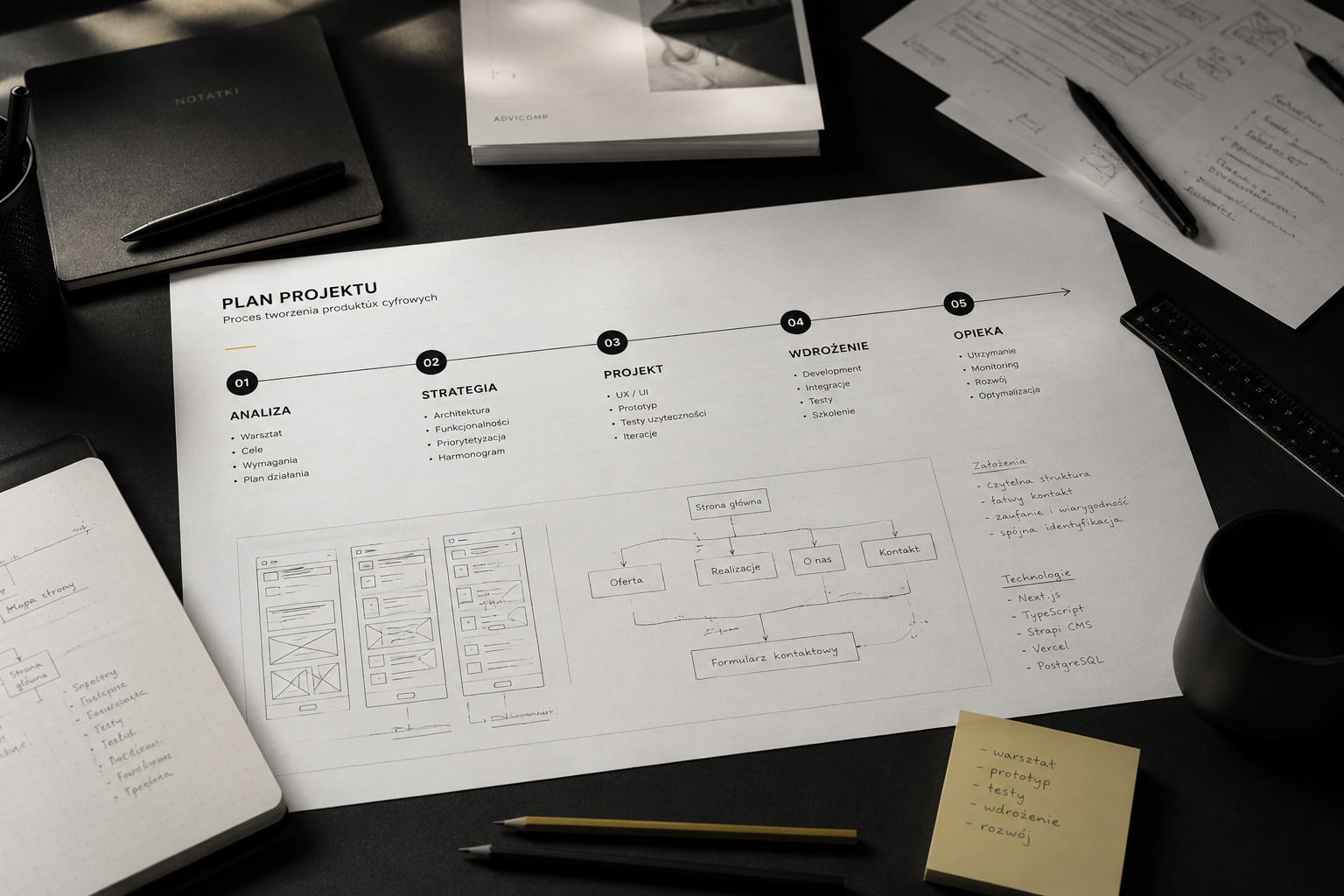
Collaboration process

People who know what they are doing
and deliver results.

We work in weekly sprints so the team sees progress, responds to risk quickly and makes decisions based on working outcomes rather than promises alone.

It is a simple rhythm for websites, campaigns, automation and systems — adapted to the scale, but always clear on both sides.

Project plan and stages of collaboration

We start with reality

A good technology decision requires understanding the client’s business.

Not every project needs an on-site visit. But when a process depends on a physical place, equipment, documents or several roles working together, an online conversation alone is not enough.

01

On-site discovery when the process happens beyond the office

When team work happens on a production floor, in a warehouse, at a client site or across locations, we come on site. Observing real work reveals more than a process description in a presentation.

02

Conversations with the people who work in the process

We ask about exceptions, manual workarounds and the moments where decisions are actually made. This keeps us from designing for an ideal scenario that never happens.

03

A shared picture of what needs to change

After discovery, we turn observations into a specific goal, priorities and the boundaries of the first stage. Your team knows what we are testing, and we know how to recognise that the change works.

A weekly rhythm

From plan to the next decision in five working days.

A sprint is not an end in itself. It is a steady way to make small, verifiable progress without losing business context or postponing important questions until the project’s end.

  1. 01
    Start of the week

    Sprint goal and plan

    We agree on one most important outcome, the scope and decisions needed from the client.

  2. 02
    During the week

    Work, testing and ongoing contact

    We design, build or optimise. We surface risks quickly instead of leaving them until the end of the project.

  3. 03
    End of the week

    Demo, insights and the next decision

    We show a working outcome, gather feedback and choose the next sensible step together.

Technology

We choose tools for the problem, not problems for the tools.

Technology should shorten the path to an outcome and remain maintainable after launch. Below are the tools we use most often — not a closed catalogue or a promise to use all of them.

01

Websites and interfaces

Company websites, content platforms and interfaces that are clear for users and comfortable to develop further.

  • WordPress
  • React
  • Next.js
  • TypeScript
02

Applications and automation

Internal tools, integrations and automation that remove manual, repetitive work from the team.

  • Python
  • Node.js
  • FastAPI
  • REST APIs
03

Data and foundations

Databases, permissions and infrastructure matched to project scale, security and ongoing maintenance responsibility.

  • Supabase
  • PostgreSQL
  • Auth
  • Cloud
04

AI where it creates an advantage

We use language models for knowledge retrieval, document workflows and decision support — with clear inputs and human oversight.

  • OpenAI
  • Claude
  • RAG
  • Workflows

The first step

Show us what needs to start working better in your company.

We will start with a conversation about the goal, context and the nearest sensible decision. If the project needs on-site discovery, we will establish that straight away.

Discuss the process